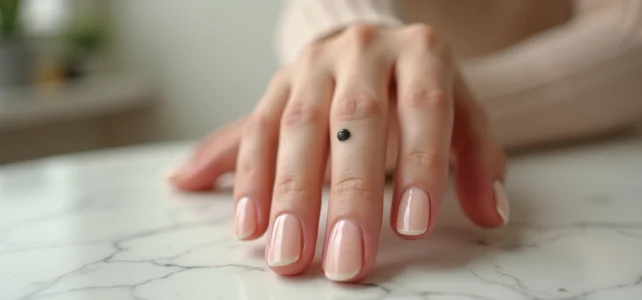
A new mole appears on the index or ring finger, and the first reaction oscillates between symbolic curiosity and medical reflex. Before searching for a hidden message in this small pigmented spot, it’s beneficial to understand what traditions attribute to each finger, and then to apply the right filter: that of skin monitoring.
Mole on the fingers: what dermatology recommends as a priority
The fingers are part of the acral areas, where pigmented lesions are more difficult to spot early. According to the American Academy of Dermatology Association, a new or changing digital mole (asymmetry, irregular border, heterogeneous color, rapid evolution) should be evaluated without delay.
In this area, it is easy to confuse a mole with a wart, a trauma, or a benign spot. This potential delay in diagnosis explains why modern dermatology emphasizes evolution more than location. The ABCDE grid (asymmetry, border, color, diameter, evolution) remains the reference tool, regardless of which finger is involved.
When exploring the meaning of moles on the fingers, it is important to keep this medical foundation in mind: any symbolic reading comes after dermatological verification, not before.

Meaning of moles according to the finger: thumb, index, middle, ring, little
Several traditions, from European palmistry to Chinese astrology, associate each finger with a planet or energy. The mole would then amplify or nuance this energy. Here are the most common correspondences.
Thumb: will and thread of personality
The thumb is linked to personal will and decision-making ability. A mole on the right thumb traditionally indicates a personality that naturally imposes its rhythm. On the left thumb, it suggests an inner stubbornness, a strength that is not always visible.
Index: ambition and sign of leadership
The index corresponds to Jupiter in European palmistry. A mole in this position is interpreted as a sign of ambition and energy directed towards action. The right index points to visible leadership, while the left index suggests a strategic analysis from the background.
Middle: responsibility and structure
Associated with Saturn, the middle finger touches on themes of discipline and rigor. A mole on this finger reveals, according to these reading grids, a personality attracted to structuring frameworks. Feedback varies on this point: some traditions also see a tendency towards voluntary isolation.
Ring: creativity and emotional life
The ring finger, connected to the Sun or Apollo, carries the creative and relational dimension. A mole on the ring finger is often read as a marker of strong emotional energy, with pronounced artistic sensitivity. The left ring finger, which traditionally carries the wedding ring in European culture, concentrates more interpretations related to romantic life.
Little: communication and intuition
The little finger corresponds to Mercury. A mole on this finger is associated with a natural communication ability and sharp intuition in exchanges. On the right little finger, the reading points to eloquence; on the left, to discreet receptivity.
Right hand or left hand: a reading that changes according to tradition
The right/left distinction is not anecdotal in these analytical systems. In Chinese palmistry, the left hand reflects innate potential (what one receives at birth), and the right hand reflects what one builds throughout life. European palmistry sometimes reverses this attribution depending on the schools.
Specifically, a mole on the right index does not have the same reading as a mole on the left index. The right hand is often associated with intention projected outward, while the left is linked to inner energy and family heritage.
This distinction applies finger by finger. Before drawing conclusions, one first identifies the finger, then the hand, and then the position on the phalanx (base, middle, tip), as each combination refines the interpretation.

Color and size of the mole: criteria that also matter in symbolic reading
The color of the mole alters the traditional interpretation. The main distinctions are as follows:
- A light brown or honey mole is read as a positive sign, carrying a gentle and constructive energy in terms of personality.
- A dark brown or black mole is interpreted as more intense energy, sometimes associated with challenges or blockages to overcome.
- A reddish or pink mole, rarer on the fingers, is linked to a vivid emotional energy and heightened sensitivity.
Size also plays a role. A large mole is considered more significant in reading, while a small pigmented spot is seen as a secondary nuance of personality.
These symbolic criteria do not replace medical monitoring in any way. A change in color, size, or shape remains primarily a dermatological signal to be checked.
How to use these interpretations without falling into over-interpretation
One can be interested in the meaning of moles on the fingers as one consults an astrological chart: with curiosity, without making it a life diagnosis. The traditions that inform these readings (palmistry, Chinese astrology, metoposcopy) do not have scientific validation, but they offer a framework for reflection on personality.
- First, check the medical aspect of the mole with a dermatologist, especially if it has appeared recently or is changing.
- Cross-reference the reading of the finger, the hand, and the color to obtain a coherent interpretation rather than an isolated shortcut.
- Do not modify life decisions based on a mole, but use it as a starting point for personal introspection.
The boundary between symbolic and medical remains clear. A mole on the left middle finger may nourish reflection on one’s personality, but a mole that itches or bleeds calls for a dermatologist appointment, not a palmistry session.