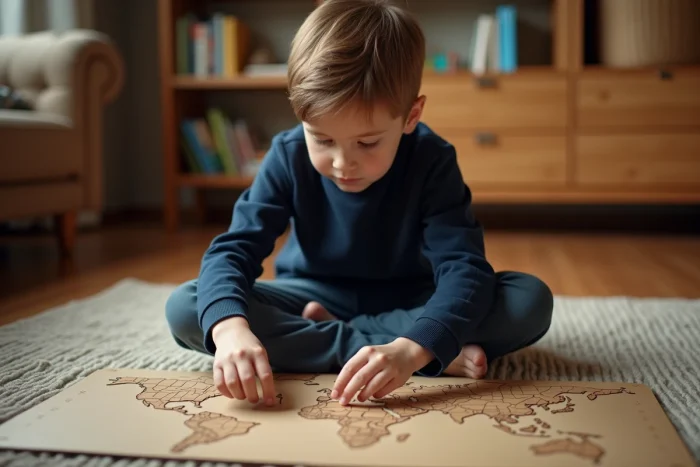
A three-year-old who systematically flips pieces to orient them before placing them, without fumbling, without looking at the model: this precise gesture indicates a visuospatial ability that goes beyond simple play. Puzzles engage mental rotation, shape perception, and spatial awareness, distinct skills from overall high intellectual potential. Recognizing these signals early allows for guiding the child towards activities that truly nurture their talent.
Mental rotation and puzzles: a visuospatial talent in its own right
Early development is often associated with a rich vocabulary or early reading. Puzzles engage a different cognitive register. A child who excels in spatial assembly may achieve average results in verbal comprehension, and vice versa.
Recent research clearly distinguishes specific visuospatial talents from homogeneous high intellectual potential. British and American studies show that a very high level of success on puzzle-type tasks correlates with skills in technical drawing, geometric reasoning, and in STEM fields, even when overall IQ remains average.
In practical terms, we seek to recognize a child gifted in puzzles by observing how they manipulate the pieces, not just the speed at which they finish the board. A child who mentally anticipates the rotation of a piece before grasping it demonstrates a measurable spatial projection ability.
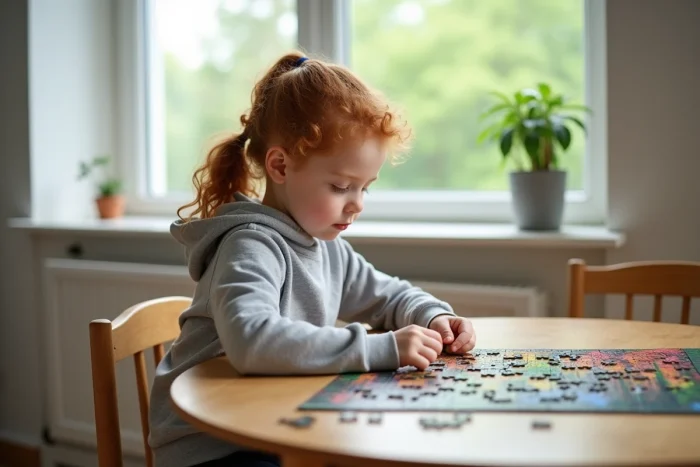
Concrete signs of a child gifted in puzzles before the age of five
Forget generic lists of precocity traits. For puzzles, the markers are observable at home, without formal testing.
- The child spontaneously sorts pieces by shape or color before starting, revealing an early visual categorization strategy.
- They work without a visible model or deliberately turn the box over, preferring to reconstruct the image mentally.
- When faced with a puzzle that is too simple, they redo it starting with the inner edges rather than the frame, a sign that they are seeking an additional challenge on their own.
- They show interest in 3D puzzles, tangrams, or interlocking puzzles well before the age indicated on the packaging.
These behaviors do not guarantee a diagnosis of high potential. They point to a visuospatial ability that deserves to be nurtured, regardless of the traditional educational path.
Early puzzle games and math skills
Longitudinal studies in the vein of Susan Levine show that children who regularly play with puzzles between the ages of two and four develop better mental rotation skills and number comprehension a few years later. The effect persists even after accounting for family socio-economic status.
The puzzle acts as an accessible and low-cost spatial training tool. We are not talking about structured educational programs, but about free play with physical pieces. Concrete manipulation—turning, flipping, trying, adjusting—builds mental representations that screens alone do not replicate with the same effectiveness.
For parents who spot a talent, the temptation is to quickly increase the difficulty. Feedback varies on this point: some children progress better with puzzles slightly above their level, while others become discouraged if the jump is too great. Observing the child’s reaction to assembly failure provides a better indicator than the number of pieces on the box.
Which puzzles to choose by age
Before three years old, knobbed shape sorters and wooden puzzles of four to eight pieces are sufficient to identify early strategies. Between three and five years old, puzzles of twenty to fifty pieces without a visible model allow for testing spatial memory.
Beyond five years old, tangrams, 3D puzzles, and pentomino-type puzzles challenge mental rotation at a higher level. These materials are more revealing than a classic hundred-piece puzzle, which primarily tests patience.
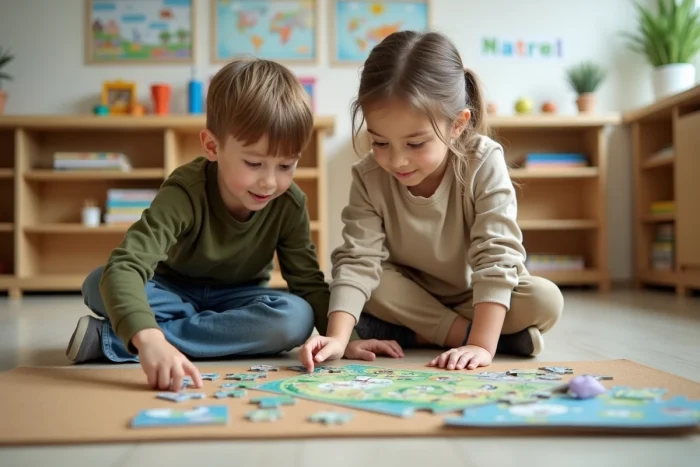
Nurturing talent without turning play into a chore
A child gifted in puzzles does not need to be subjected to daily sessions. Visuospatial skills also develop through related activities: building with blocks, observational drawing, origami, board strategy games.
The goal is to diversify the materials without leaving the spatial register. A child who excels in puzzles may find a natural extension in visual programming with blocks, modeling, or mapping.
Some operational principles:
- Let the child choose the difficulty. If they ask for a more complex puzzle, provide the material without directing the method.
- Do not time them. Speed is not a reliable indicator of spatial talent; the assembly strategy is more telling.
- Offer mixed activities: a tangram followed by free drawing allows the child to transfer their spatial skills to another medium.
When to consult a psychologist
If the child shows marked advancement in spatial tasks but encounters academic or social difficulties, a psychometric assessment (like WISC) can help objectify the cognitive profile. The WISC subtest “cubes” precisely measures visuospatial reasoning and can confirm a localized peak of ability.
A heterogeneous profile, strong in spatial but average or weak in verbal, often goes unnoticed at school. Parental identification remains the first lever of action, well before formal educational guidance.
Giftedness in puzzles is not an educational gimmick. It is a measurable marker of spatial talent that, when identified early and supported with appropriate materials, opens concrete doors to sciences, engineering, and visual design professions.