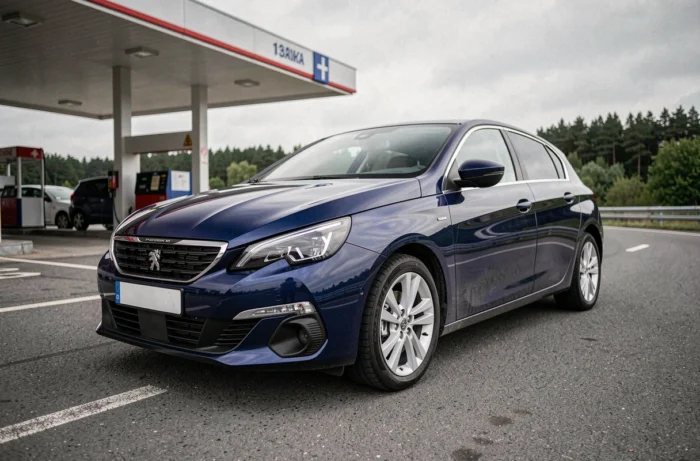
The diesel Peugeot 308 III equipped with the 1.5 BlueHDi 130 has now built up several years of real-world feedback under intensive use. VTC fleets, sales representatives, daily motorway commutes: high-mileage drivers who travel well above the annual average provide the best test of this engine’s reliability. Their verdict is about more than engine longevity. It also takes into account unexpected downtime, the real cost of emissions-control systems and, more recently, access to city centres.
1.5 BlueHDi camshaft chain: a dividing line between older and newer model years
A topic that forums often discuss confusingly deserves a clear explanation. The 1.5 BlueHDi camshaft chain was reinforced on engines produced from February 2023 onwards. For a diesel 308 built before that date, the question is not whether the engine “holds up” in general, but whether the specific vehicle you are considering has received the upgrade.
A rattling chain on a cold start is the first warning sign. On 2021–2022 models, this symptom comes up regularly in high-mileage drivers’ accounts. Stellantis may offer special coverage, but strict conditions apply: eligibility can only be confirmed using the VIN and up-to-date maintenance records.
Feedback compiled in the 2026 reviews of the diesel 308 confirms this divide between early model years and updated versions. A high-mileage driver buying a used 308 BlueHDi without checking the engine’s production date is taking a measurable risk—not in terms of the engine’s overall lifespan, but of potentially spending several days without the car while it is in the workshop.

Diesel 308 recalls and VIN checks: what real-world feedback doesn’t always tell you
Recent recalls affecting the 1.5 BlueHDi do not apply to the entire fleet. Online discussions tend to overgeneralise this point. Only a VIN check with the manufacturer or against the official database can confirm whether a specific vehicle is affected and whether the work has been carried out.
For a high-mileage driver, the stakes go beyond the repair itself. Three to five days off the road for an unplanned recall means a direct loss of business. Sales representatives on the road and VTC drivers posting on forums mention this risk more often than engine failure itself.
AdBlue, DPF and SCR system: three separate checks
The BlueHDi 130’s emissions-control system includes several components that age independently. Software and sensor updates rolled out by Peugeot in late 2024 have reduced the number of limp-mode incidents linked to AdBlue, a major source of frustration on 2021–2023 models.
High-mileage drivers report a noticeable improvement after these updates. The particulate filter and SCR catalyst still need to be monitored separately. A DPF clogged by excessive urban driving and a faulty SCR system can cause similar symptoms (loss of power, engine warning light), but the causes and repair costs differ.
- The AdBlue system (level sensor, injector, tank) benefited from the updates in late 2024, but vehicles that have not been updated remain at risk of repeated limp-mode incidents.
- The particulate filter does not regenerate properly on short, exclusively urban trips—a paradox for high-mileage drivers who alternate between city and motorway driving.
- The SCR catalyst can fail independently of the AdBlue system, and replacement costs can put a strain on the maintenance budget for long-distance driving.
Crit’Air 2 diesel 308 and low-emission zone restrictions: the factor high-mileage drivers underestimate
Mechanical reliability is only part of the equation. A recent diesel 308 is classified as Crit’Air 2, which currently allows it to drive in most low-emission zones. The situation could change depending on local decisions.
For high-mileage drivers whose routes regularly pass through urban centres subject to restrictions, this matters as much as engine longevity. Several local authorities already ban Crit’Air 3 vehicles, and the timeline for extending these restrictions remains a matter of local political debate.
The missing information here is what each urban area plans to do beyond 2026. There is no uniform national timetable setting a ban date for Crit’Air 2 vehicles. Every high-mileage driver should check the low-emission zone rules for their usual routes before committing to a diesel, even a recent one.
The real cost of BlueHDi 130 downtime under intensive use
Feedback from professional fleets points to a recurring pattern. The engine itself handles high mileage without major problems when it is properly maintained. What costs money is not the part—it’s the downtime.
A faulty AdBlue sensor on a vehicle that has not been updated can trigger limp mode, limiting speed and making the car unusable on the motorway. Waiting for a dealership appointment, parts availability and diagnostics can add days off the road—something the cost of the part alone does not reflect.
- On models that have not been updated, AdBlue-related limp mode can occur without any prior warning.
- Average dealership wait times vary by region, and high-mileage drivers report delays of several days during busy periods.
- Lost business (missed income, replacement vehicle hire) often costs more than the repair itself.
For a high-mileage driver, the true measure of reliability is not the engine’s maximum mileage, but the number of days the vehicle is off the road each year. By this measure, 308 BlueHDi models produced after February 2023 and updated in late 2024 perform noticeably better than the earliest models. For those driving an older vehicle, checking the VIN, update history and eligibility for Stellantis coverage should be the first step before making any commitment.