
A raw figure to start with: nearly 80% of consumers claim to have taken advantage of a “free” product thinking they would benefit from true free-of-charge. However, behind these enticing operations, the reality is often less clear than it seems.
A product labeled as “free” does not necessarily mean you will pay nothing in the end. Major retailers excel in the art of presentation: they orchestrate promotions where the discount seems striking, while the actual savings can sometimes be much more modest.
French legislation does not use the words “free” and “complimentary” in the same way, which opens the door to some ambiguity on receipts or in store aisles. Brands skillfully play with this nuance, exploiting our perception of the advantage. The result: our purchasing decision is influenced by well-established psychological triggers, often unbeknownst to us.
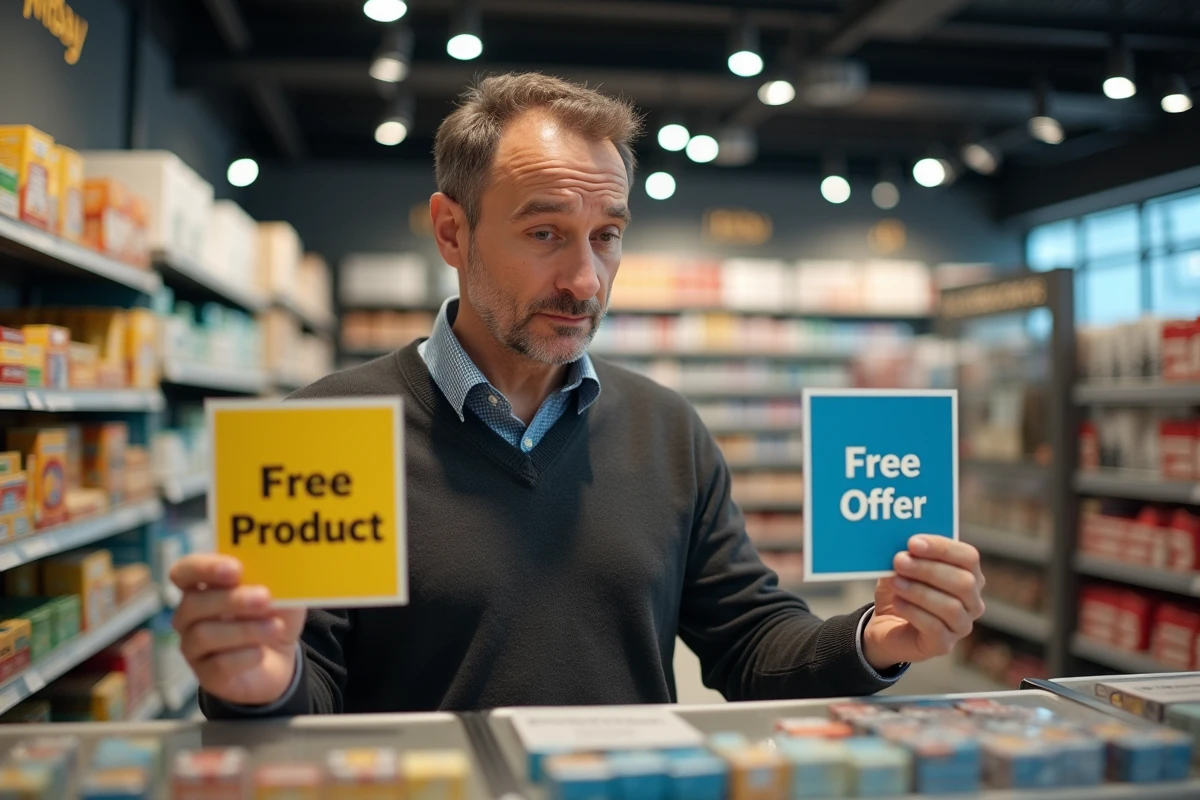
Why do we distinguish between a complimentary product and a free offer?
The difference between complimentary and free offer is not just a semantic subtlety: it shapes the relationship between the buyer and the brand. A complimentary product almost always implies a trade-off: prior purchase, signing up for a newsletter, or consenting to share personal data. The free offer, on the other hand, highlights the total absence of payment, at least on the surface. But behind this promise, few offers come without any expectation in return. The nuance lies in the detail: content presented as free attracts attention, builds an audience, and subtly guides towards paid services. In contrast, a product or service that is “complimentary” often requires you to take concrete action, make a purchase, sign up, or fill out a form. Behind each formula, a specific goal: to enhance brand awareness, attract new customers, or enrich a prospect database. In France, brands juggle these concepts to generate interest, trigger purchases, or establish a relationship of trust. Receiving a gift creates a sense of mutual obligation; you find yourself, unconsciously, indebted. Nothing is quite the same with genuinely free content, consumed without immediate expectation. What seems free can also just be bait: a sample attracts, but paves the way for paid or premium offers.
| Type of offer | Counterpart | Objective |
|---|---|---|
| Complimentary product | Purchase, registration, data | Retention, awareness, conversion |
| Free offer | None (apparently) | Attraction, testing, visibility |
To see clearly in this game of appearances, consult the difference between complimentary and free offer: it will help you decode the strategies in place, from simple samples to services that seem free of charge.
The rule of three: a simple tool to spot real promotions
To avoid being misled by flashy offers, the rule of three remains a reliable and accessible method for everyone. In the face of a profusion of promotions, caution is essential. Remember to calculate, compare, and examine the total price before finalizing your cart. Free shipping, a gift with purchase, or a bonus do not necessarily make the whole more interesting for your wallet.
To apply this principle, here are the steps to follow:
- Start by noting the usual price of the targeted product or service.
- Add to this price any potential additional costs: shipping, warranty, special edition, etc.
- Subtract the actual value of what is offered (gifts, vouchers, loyalty benefits).
This calculation allows you to obtain the real price, far from commercial slogans. Promotions like “buy one, get one free” (BOGO) are only worthwhile if you actually needed both items. Loyalty programs or gift cards may seem attractive, but their relevance will depend on their actual use in your daily life.
When faced with a promotional offer, take the time to check if the announced advantage truly alters the price paid. The rule of three allows you to clearly distinguish the genuinely advantageous offer from mere marketing packaging. This reflex protects you from false good deals and helps you better invest your budget.
Avoiding traps: practical tips to avoid being fooled in-store
In the face of an escalation of free offers and enticing promises, the informed consumer must sharpen their vigilance. It is necessary to untangle true freebies from conditional generosity: mandatory registration, transmission of personal data, or minimum purchase. Ask yourself: what hidden counterpart lies behind this complimentary product? Commercial operations are full of subtleties, rarely explained.
Some distributors send multiple unsolicited samples. This practice, which can be reported via SignalConso, raises questions about our consumption habits and their environmental consequences. Massively offering products is never trivial: the brand benefits, whether in visibility or revenue. To avoid falling into the trap, it is important to take a step back: analyze the actual usefulness of the proposed advantage, and ask yourself if it meets a concrete need.
To enhance your discernment, keep these key points in mind:
- Always consider the total price, including benefits and any additional costs.
- Do not be seduced by services advertised as free: check that there is no deferred billing or obligation for future purchases.
- Protect your data: never agree to share your information without a real and transparent counterpart.
Marketing loves to disguise commercial offers as charitable or ecological gestures. Michael Aguilar warns against false freebies, which rely on consumer trust to better divert it. Before succumbing to the temptation of the complimentary product, weigh the balance between immediate benefit and long-term commitment. The true gift may be the one you choose to refuse.