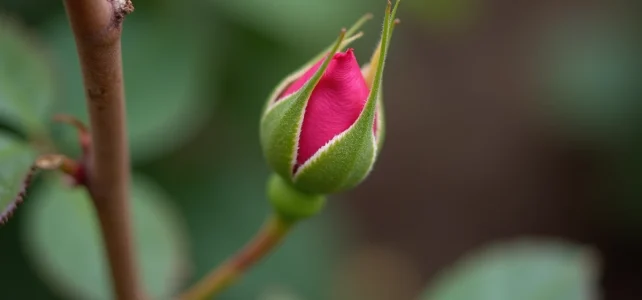
On a rose bush, each dormant bud on a stem is called an “eye.” This small swelling, often discreet under the bark, concentrates the plant’s growth potential: it is from this point that future branches, leaves, and ultimately flowers will emerge. Understanding what a rose eye is, knowing how to spot it, and adjusting the pruning according to its position radically changes the vigor and flowering of a plant.
Anatomy of the rose eye: what a simple swelling conceals
The eye appears as a small bump located at the axil of a leaf or a leaf scar, on the wood of the year or on older wood. Its shape varies according to the varieties: some tea hybrids show prominent eyes that are easy to identify, while in climbing roses, they remain flatter and blend in with the bark.
Inside this eye is a meristem, a plant tissue capable of dividing to produce a new shoot. As long as the eye remains dormant, it serves as a reserve for growth. Once activated by pruning, light, or the rise of spring sap, it breaks dormancy and gives rise to a shoot.
The orientation of the eye determines the direction of the future branch. An eye facing outward from the bush will produce a shoot that moves away from the center, which opens up the silhouette of the rose bush and reduces stagnant moisture between the stems. Conversely, an eye facing inward closes the structure and promotes conditions conducive to fungal diseases.
To deepen the definition of the rose eye, one must go beyond the visual aspect and consider its architectural function in the development of the plant.
Pruning to three or five eyes: adapting the action to the climate
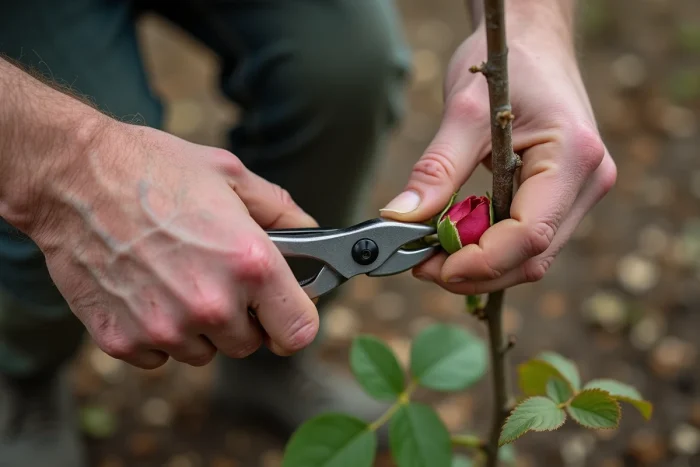
The classic rule recommends pruning bush roses to three or five eyes above the ground. This number is not arbitrary: it sets the compromise between the vigor of the shoots (the fewer eyes retained, the more sap each shoot receives) and the overall volume of the bush.
Tests conducted by INRAE and the Association of French Rosarians since 2020 indicate a trend towards shorter pruning in regions where springs are becoming drier. Reducing from five or six eyes to three or four limits the leaf mass and reduces water stress on modern roses. This adaptation is explicitly linked to the increasing frequency of spring drought episodes that Météo-France documented in its 2022 annual climate report.
For tea hybrids and bouquet roses planted in beds, the common guideline remains to prune the main branches to three or five eyes by cutting off weak shoots, while retaining about five framework branches. Climbing roses and shrubs require a different treatment: more old wood is retained and eyes are selected on lateral shoots.
Position of the cut relative to the eye
The Société Nationale d’Horticulture de France (SNHF) has compiled field observations between 2019 and 2023 that indicate a correlation between poorly positioned cuts and an increase in disease entries. Cutting too close to the eye damages it. Cutting too far leaves a stub of dead wood that serves as an entry point for fungi.
- The ideal cut is made about one centimeter above the eye, at an angle, with the slope facing away from the bud so that rainwater drains off without stagnating on it.
- The pruning shears must be clean and well-sharpened: a crushing blade tears the fibers instead of cutting them, which slows healing.
- A horizontal cut retains moisture and increases the risk of gray rot or canker on the remaining stub.
dormant eyes and adventitious eyes: two distinct resources
Not all eyes on a rose bush are equal. Dormant eyes, located on the wood of the previous year, are the ones the gardener targets during late winter pruning. They are programmed to break dormancy in the following spring.
Adventitious eyes, on the other hand, form on older wood, sometimes very low on the stump. They serve as a backup reserve that the plant mobilizes when the upper part is damaged by frost, breakage, or severe pruning. A severely cut rose can regrow from these adventitious eyes if the graft (the junction point between the rootstock and the cultivated variety) is intact.
This distinction has a direct practical interest. During a harsh winter, a rose bush whose stems have frozen to the ground is not necessarily lost. Before uprooting it, it is better to wait for the sap to rise and see if any shoots emerge from the base. These are the adventitious eyes that take over.
Spotting an eye in the field: reliable visual clues
On a shoot of the year, the eye is located just above the scar left by the petiole of a fallen leaf. In winter, when the rose bush is leafless, these leaf scars remain visible as small crescent-shaped marks.
- On green or light brown wood, the eye is often reddish or slightly pink in dark-flowered varieties.
- On mature gray wood, it appears as a darker spot, sometimes surrounded by a slight swelling.
- Thorns can serve as a marker: in many varieties, an eye is located very close to a thorn or just below it.
A swollen and shiny eye is a viable eye. A dry, blackened, or flattened eye has likely been damaged by frost or disease and will not produce anything good. During pruning, it is better to go down a notch and cut above the next healthy eye, even if it shortens the branch further.
The act of spotting becomes instinctive after a few seasons. Taking the time to observe your roses in winter, pruning shears in hand, before cutting anything remains the best way to learn to read these clues. The quality of a pruning depends less on the height of the cut than on the choice of the targeted eye, its orientation, and its vitality.