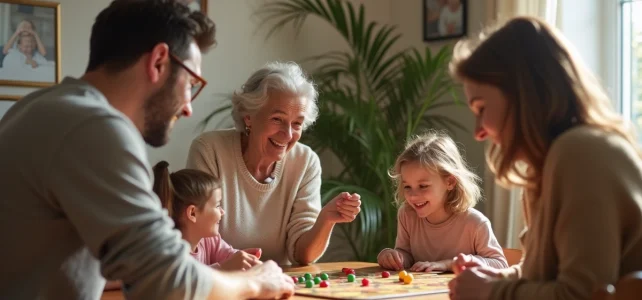
Poor management of family disagreements significantly reduces life satisfaction and mental health, according to several studies conducted in Europe. Some families maintain a serene atmosphere despite busy schedules or marked differences among their members. The most balanced dynamics generally rely on simple, sometimes unexpected routines that foster cohesion. Concrete strategies exist to create a more peaceful environment and strengthen bonds. Minor adjustments in daily organization often suffice to sustainably transform the quality of exchanges and relationships.
Why family harmony is sometimes a daily challenge
Daily family life rarely resembles a walk in the park. Between clashing personalities and disrupted rhythms, tensions inevitably arise. Each member, child or adult, comes with their baggage, vulnerabilities, and needs: cohabitation sometimes ignites real campfires under the roof. Yet, the heart of the matter does not lie in avoiding disagreements at all costs, but in the collective ability to navigate them without losing the thread of the relationship.
See also : 10 Tips for Parents Together to Strengthen Family Harmony Daily
In the rush to keep up with schedules, under the pressure of work or activities, family balance quickly becomes fragile. Screens take over, a teenager retreats behind a closed door, a dispute erupts over forgotten rules. Sometimes, communication is reduced to monosyllables, sometimes voices are raised over chores, and sometimes we throw our hands up in despair. All of this gradually gnaws away at each person’s mental health.
Hence the importance of setting benchmarks, not to confine, but to reassure. House rules deserve to be discussed, adjusted, and collectively understood. A co-constructed framework gives meaning and diffuses many silent frustrations. More than authority, it is the sharing of the rules that calms.
Read also : Forgotten TSA007 Code on Your Luggage: Solutions and Practical Tips to Know
For those who wish to delve deeper into these topics and find concrete ideas to adapt: read on Vive Mon Bébé.
What small changes can transform communication at home?
Family exchanges are not limited to logistical management or reminders. Everything hinges on how each person feels heard, welcomed, and considered. Offering genuine moments of listening, respecting the other’s words as well as their silences, gradually changes the atmosphere of the home.
Simply changing one’s posture already transforms a lot: substituting “I” to talk about oneself for the accusatory “you,” softening the tone, questioning differently. A real-life example: Facing a mute child after school, asking “What surprised you today?” opens more doors than “How are you?” Saying “I feel invisible when you don’t respond” instead of “You always ignore me” changes the game.
Here are simple levers to facilitate dialogue and strengthen mutual understanding:
- Encourage a positive approach: recognize efforts, encourage initiatives, value the journey rather than the final goal.
- Highlight gratitude in daily life: thank for gestures, make recognition visible, establish small warm rituals around gratitude.
- Discuss the living framework together: define, explain, evolve the rules, so they become a foundation rather than a straitjacket.
Creating regular spaces to reconnect, a shared meal, an activity where everyone contributes their touch, even modestly, and banning screens for an evening, allows needs and desires to be expressed. Family communication is built this way, stone by stone, over the days.

10 concrete tips to cultivate well-being and closeness in the family
Family balance is nourished by ordinary gestures, but it requires a clear willingness to reweave bonds when they fray. There’s no question of aiming for perfection: more often than not, a few sincere rituals, moments where we truly give each other time, are enough to change the atmosphere at home. A leisurely dinner, an impromptu walk, a collective DIY workshop do more than a series of orders thrown between two notifications.
To build this calm and lasting climate, different practices naturally come into play:
- Establish collective routines: display an accessible schedule for all, provide benchmarks, establish reassuring habits without confining.
- Transform household tasks into opportunities for collaboration: distribute missions, value joint efforts, celebrate small household victories.
- Live out gratitude: acknowledge initiative, thank sincerely, find a reason for recognition every day, even if tiny.
- Initiate unifying activities: board games, creative workshops, culinary or sports challenges bringing each generation together around a shared goal.
- Organize calm time together: moments of reading aloud, relaxation breaks, simple breathing exercises to regain breath and ease tensions.
It is often these modest but regular habits that sustainably establish harmony and closeness. When words flow without fear, when everyone feels their place is respected, and when conflicts are resolved without winners or losers, family life becomes a solid support against the upheavals from outside. Ultimately, it is these repeated, almost trivial gestures that forge family memory and uphold the structure, even when the winds rise.